
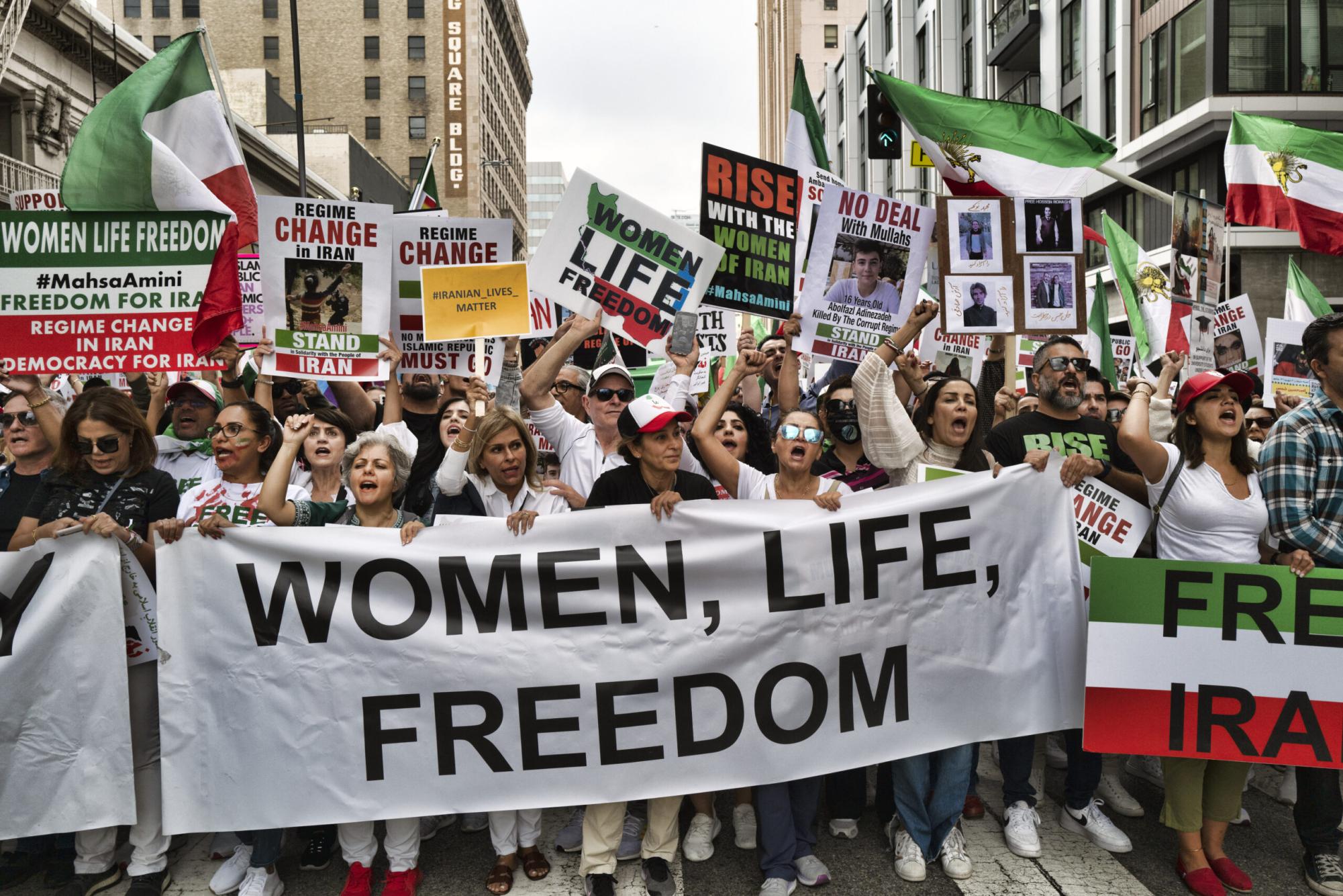
On December 28, 2025, widespread protests erupted in Iran, spurring on one of the most significant periods of social upheaval the country has faced in years. The demonstrations initially began in Tehran’s Grand Bazaar when shopkeepers closed their businesses in response to rapid inflation and the decline of Iran’s national currency: the rial. To put the decline of the rial into perspective, according to Iran International, 1 U.S. dollar is currently the equivalent of 1,070,000 IRR compared to the 500,000 IRR it was equivalent to in 2023. However, these economic grievances were only the catalyst for larger public demonstrations addressing issues from women’s rights to human rights violations.
By early January 2026, the protests had quickly spread to other major cities within the country, including Mashhad, Shiraz, and Tabriz. However, these events must be situated in the context of Iran’s current political system. Established in 1979 following the Islamic Revolution—which overthrew the monarchy of Shah Mohammed Reza Pahlav—the Islamic Republic operates as a hybrid system. This system combines the elected bodies (the president and parliament) with the unelected bodies overseen by the Supreme Leader, a position held by Ayatollah Ali Khamenei since 1989.
It remains that protests and public demonstrations have been a central part of Iranian history. In March of 1979, shortly after the revolution, thousands of women marched in Tehran to protest the introduction of mandatory hijab laws. And since then, larger protests have challenged everything from freedom of the press, to disputed elections, to greater economic concerns. However, the current wave of protests has been described as one of the largest in the country’s recent history. When asked about the reason for this recent rise in activism, Social Studies teacher Dr. Susan Chester commented that “It was almost like this simmering unrest or this simmering dissatisfaction with the regime in general,” noting that decades of history had pushed many Iranian people to their breaking point.
As these protests bled into the new year, the Iranian government implemented significant security measures to control the demonstrations. Both law enforcement and paramilitary forces were deployed to disperse crowds, often engaging in violent confrontations resulting in thousands of casualties. Additionally, beginning on the 8th of January, all 92 million of the country’s citizens have been almost completely cut out from the global internet, marking one of the longest and most comprehensive shutdowns in the nation’s history. This makes it nearly impossible for those outside the country to verify reports. As Sadie Bilik (’27) noted, “It is difficult to know what news is an accurate reflection of what is really happening there when there is such a large blackout.”
While these events have drawn a significant amount of international attention, they also draw attention to how we as students engage with and understand global news. When asked about their knowledge of the situation, many students noted that they knew little about it. Brynn Hektor (’27) reflected that this lack of knowledge is potentially linked to the availability of news sources: “With most news being electronic it’s harder to access current events in an unbiased manner. If you don’t go looking for the news it’s a lot harder to find it.” Similarly, when asked about how students have been engaging with conflicts like Iran in class, Dr. Chester mentioned that “not a single student has asked me about Iran… They’ve asked me about ICE, they’ve asked me about Venezuela and Greenland, and they’ve asked me about Minneapolis, so I think those are front of mind for folks. Iran is far away, and maybe it’s not being talked about as much where students are exposed to news.”
While it can be easy to get wrapped up in U.S. affairs and occasionally disregard the many other issues going on in the larger world around us, as Dr. Chester remarked, “It’s important for young Americans to really understand the importance of our Constitution and our Bill of Rights, and then how that does not necessarily exist in other places.” Interacting with current events in our current day and age can be difficult, especially when that information is constantly distorted. But, it is crucial to “understand that instability in any part of the world affects the entire world,” said Chester..
Although we do not know what the future holds in regard to Iran, it is important that we continue to keep up with current events even if we are not directly affected by them. As cognizant citizens, we have a duty to advocate for the issues we see around us, including ones overseas.